Why Your New Boss Wants This on Day 1 (And How to Deliver It)
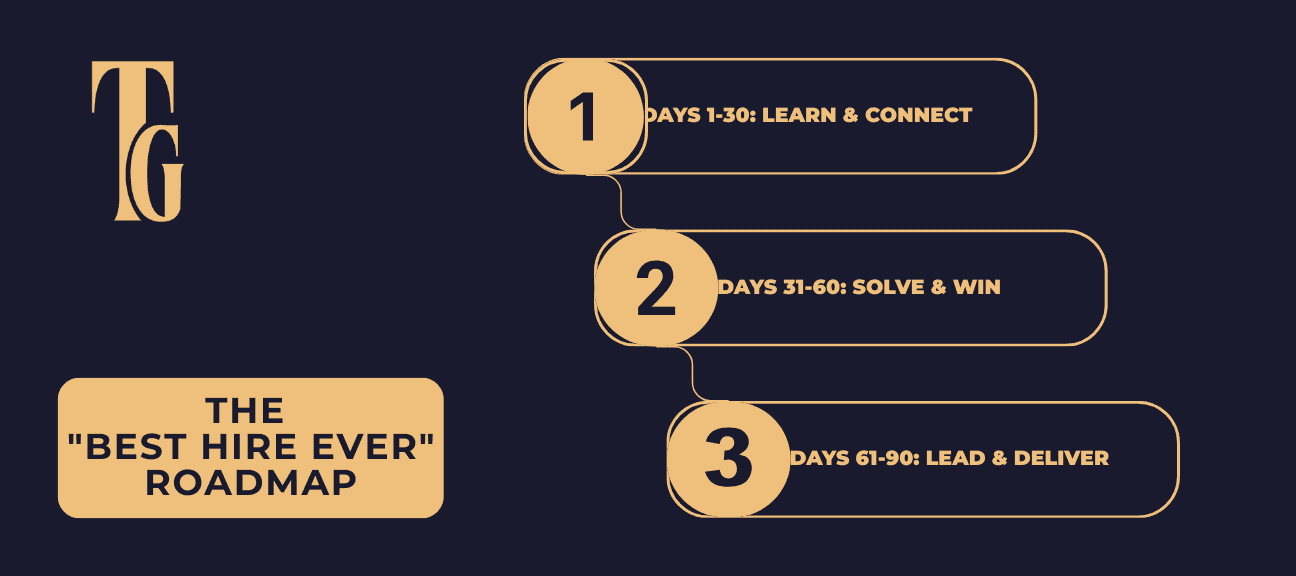
Senior leaders who nail their first 90 days show up with a plan. Here's how.
Why Your New Boss Wants This on Day 1 (And How to Deliver It)
You just accepted the offer. $320K package. VP of Revenue at a Series C company scaling fast.
Monday is Day 1.
Here's what most executives do:
Show up. Smile. Say "I'm excited to be here." Wait to be told what to do.
Here's what the executives who become "best hire ever" do:
Show up with a documented 90-day plan already built.
The difference between those two approaches?
One executive spends their first 90 days figuring out what to do.
The other spends their first 90 days delivering results.
As Endeavor Executive puts it:
"A well-thought-out 30-60-90-day plan helps executives onboard more efficiently, align with organizational goals, and build credibility through measurable results."
That's not aspirational. That's what happens when you walk into Day 1 with a plan already documented.
Your new boss isn't hoping you'll figure it out. They're hoping you already have.
Here's exactly what they want to see on Day 1—and how to deliver it.
What Your New Boss Is Actually Thinking on Day 1
Let's get inside your new boss's head before you walk through the door.
They just made a $300K+ hiring decision.
That decision carries real risk. Real accountability. Real consequences if it goes wrong.
What they're thinking:
"I really hope this person is as good as I think they are."
"The board is watching this hire."
"I need results within 90 days or questions are going to start."
"Please don't make me regret this."
What they're hoping for:
Someone who can hit the ground running. Someone who doesn't need hand-holding. Someone who shows up prepared and starts delivering.
What they almost never get:
A new executive who arrives with a documented plan, a clear understanding of priorities, and specific commitments for the first 90 days.
When you show up with that plan on Day 1, here's what happens:
Your boss thinks: "This person is already functioning at the level I hired them for."
That single moment sets the tone for your entire tenure.
The Psychology of Day 1 Expectations
Day 1 is disproportionately important—and most executives don't realize it.
Here's why:
First impressions are sticky. Research consistently shows that initial impressions persist and influence perception for months. Your Day 1 behavior creates a lasting lens through which everything you do afterward gets evaluated.
Your boss is pattern-matching. They've hired dozens of people. They know immediately whether someone is the type to wait for direction or the type to take initiative.
The team is watching. Your direct reports, peers, and cross-functional partners are all evaluating you on Day 1. How you show up signals everything about how you lead.
Credibility compounds. Strong Day 1 creates momentum that compounds. Weak Day 1 creates a hole you spend months trying to climb out of.
A documented 90-day plan on Day 1 communicates three things simultaneously:
- "I take this role seriously" — You invested hours in preparation before your first day
- "I'm already thinking strategically" — You didn't wait to be told what matters
- "You can count on me to deliver" — You've committed to specific outcomes
That's the "best hire ever" signal your boss is hoping to see.
The 3-Phase Framework Your Boss Actually Wants
Not every 90-day plan is created equal. The ones that impress senior leaders follow a specific progression.
As Endeavor Executive describes the framework:
- Days 1-30: Learn the business, relationships, challenges
- Days 31-60: Contribute solutions, early wins, process improvements
- Days 61-90: Lead initiatives, deliver measurable outcomes
This sequence matters. It's not arbitrary.
Each phase builds the foundation for the next. And each phase communicates a different kind of competence to your new boss.
Phase 1: Days 1-30 — The Diagnostic Phase
What your boss wants to see: Smart listening, rapid assessment, and relationship building.
What this phase is NOT: Sitting in meetings taking notes and hoping someone explains everything.
What this phase IS: Strategic intelligence gathering with clear deliverables.
The critical distinction:
Passive learner (what most executives do):
- "I'm going to spend the first 30 days learning the business"
- Attends meetings. Takes notes. Asks occasional questions.
- Ends Day 30 with vague impressions and no deliverable.
Active diagnostician (what "best hire ever" executives do):
- "I'm going to diagnose the business in 30 days and present my findings"
- Analyzes data. Interviews stakeholders. Identifies patterns.
- Ends Day 30 with a documented diagnostic report and clear recommendations.
Here's what Days 1-30 should look like in your plan:
Week 1: Orientation and Data Collection
Meet with your direct reports individually. Not casual coffee. Structured conversations:
- What are the top 3 challenges you're facing right now?
- What's working well that we should protect?
- Where are the biggest opportunities?
- What do you wish leadership understood better?
Pull the data. Revenue trends, conversion metrics, team performance, customer feedback—whatever's relevant to your function. Don't wait for someone to give it to you. Ask for it specifically.
Meet with cross-functional partners. Understand how your function connects to theirs. Where are the friction points? Where are the opportunities to collaborate?
Week 2: Deep Analysis
Spend dedicated time analyzing the data you've collected. Not skimming. Analyzing.
What patterns do you see? What surprises are there? Where is the gap between what leadership thinks is happening and what's actually happening?
This is where your expertise becomes your advantage. You've seen these patterns before. You know what they mean.
Week 3: Stakeholder Interviews
Go beyond your direct reports. Talk to customers if possible. Talk to key vendors or partners. Talk to people who interact with your function daily.
What are they experiencing? What's frustrating them? What do they wish was different?
Week 4: Diagnostic Report
Synthesize everything into a clear, documented diagnostic:
- Current state assessment (where we actually are)
- Key challenges identified (with evidence, not opinion)
- Root causes (not symptoms)
- Opportunities identified (quick wins and longer-term)
- Recommended priorities for Days 31-60
Present this to your boss at the Day 30 checkpoint.
Why this impresses your boss:
You've just done in 30 days what most executives take 3-6 months to figure out. And you've documented it clearly, showing your analytical rigor and strategic thinking.
Your boss thinks: "This person didn't just listen and nod. They assessed and delivered. This is exactly the caliber of thinking I hired."
Phase 2: Days 31-60 — The Contribution Phase
What your boss wants to see: Early results, collaborative problem-solving, and demonstrated judgment.
This is where "learning" transitions to "delivering."
The critical distinction:
Passive contributor:
- "I'm still learning but I think I have some ideas..."
- Suggests changes tentatively
- Waits for permission before acting
- Leaves Day 60 with nothing concrete to show
Active contributor:
- "Based on my Day 30 diagnostic, here are the three initiatives I'm launching"
- Identifies quick wins and executes them
- Builds alignment and moves decisively
- Leaves Day 60 with measurable early results
Here's what Days 31-60 should look like in your plan:
Identify and execute 2-3 quick wins:
Quick wins are specific, achievable improvements that deliver visible results within 2-4 weeks.
They matter not because of their business impact (though that helps) but because of what they signal:
- "I understand the business well enough to identify opportunities"
- "I can move from insight to action quickly"
- "I deliver on what I promise"
- "I bring fresh perspective that creates value immediately"
Example quick wins by function:
Revenue leader: Implement a standardized pipeline review cadence that immediately improves forecast visibility. Done in Week 5. Results visible by Week 7.
Marketing leader: Launch one campaign targeting the highest-value segment identified in your diagnostic. Results measurable within two weeks.
Operations leader: Identify the single biggest process bottleneck and implement a fix. Document the before and after.
Launch your first strategic initiative:
Based on your Day 30 diagnostic, identify the highest-impact initiative for Days 31-60 and begin execution.
This isn't about completing it. It's about demonstrating:
- Strategic prioritization (you chose the right thing)
- Execution capability (you started moving immediately)
- Stakeholder alignment (you brought people with you)
Build key relationships deeper:
Days 1-30 were about meeting people. Days 31-60 are about building real working relationships.
Schedule collaborative working sessions. Solve problems together. Be the person who makes other teams' lives easier, not harder.
Update your boss regularly:
Weekly 15-minute check-ins: "Here's what I delivered this week. Here's what I learned. Here's what I'm focusing on next."
This isn't status reporting. It's alignment and confidence building.
Why this impresses your boss:
You've moved from listening to delivering in exactly the timeline they expected. You're showing results. You're building relationships. You're not waiting to be managed.
Your boss thinks: "They're ahead of where I expected. This might be the best hire I've made."
Phase 3: Days 61-90 — The Leadership Phase
What your boss wants to see: Measurable results, team development, and sustainable momentum.
This is where you prove you can not just deliver, but lead.
The critical distinction:
Individual contributor mindset:
- Personally executes everything
- Becomes a bottleneck
- Shows personal capability but not leadership
Executive leader mindset:
- Delivers results through the team
- Builds systems and processes that scale
- Shows capability AND leadership capability
Here's what Days 61-90 should look like in your plan:
Deliver measurable outcomes:
Whatever metrics you committed to in your 90-day plan, now is when you deliver them.
Not approximately. Not "we're making progress." Specific, measurable results that demonstrate the value of your first quarter.
Example: "Revenue conversion improved from 22% to 29% in the pipeline stages I focused on." Not "We're seeing some improvement in conversion."
Establish systems, not just results:
The best executives don't just deliver results in their first 90 days. They build systems that continue delivering after Day 90.
- Documented processes your team can follow
- Recurring cadences and frameworks
- Measurement dashboards that provide ongoing visibility
- Team development plans that build capability over time
Your boss isn't just evaluating your first 90 days. They're evaluating whether you'll continue delivering at this level for years.
Systems signal sustainability. One-time results signal luck.
Present your 90-day review:
At Day 90, present a formal review to your boss (and potentially broader leadership):
- What you committed to on Day 1
- What you actually delivered
- What you learned
- What you're planning for Days 91-180
This closes the loop on your 90-day plan and opens the next chapter.
Why this impresses your boss:
You've delivered measurable results, built sustainable systems, and demonstrated executive-level leadership in your first quarter. You've turned a $300K risk into a proven asset.
Your boss thinks: "Best hire ever. No question."
How to Actually Build This Plan Before Day 1
Here's the practical reality: You need to build this plan before your first day. Not on Day 1. Before it.
The timeline:
Week before start (10-15 hours):
- Deep research on the company, team, and challenges
- Synthesize your findings into situation analysis
- Draft your priorities and action plan for each phase
- Define success metrics for each 30-day checkpoint
- Document everything professionally
This doesn't mean your plan is final. It means you have a structured framework that demonstrates:
- You've done serious research
- You've thought strategically about priorities
- You have a clear plan of attack
- You're committed to measurable outcomes
The plan evolves. Days 1-30 are specifically designed to validate or update your hypotheses. The diagnostic process will reveal things your pre-Day 1 research couldn't capture.
But showing up with a thoughtful, researched plan—even knowing it will evolve—signals something powerful:
"I'm not waiting to be told what to do. I'm already thinking about how to succeed."
What to Include in Your Day 1 Document
Section 1: My Understanding of the Opportunity (1-2 pages)
- Current state of the business/team/function
- Key challenges as I understand them
- Opportunities I've identified
- My hypothesis about priorities
Section 2: My 90-Day Plan (3-4 pages)
- Days 1-30: What I'll learn, who I'll meet, what I'll deliver
- Days 31-60: What I'll contribute, quick wins I'll target, initiatives I'll launch
- Days 61-90: Results I'll deliver, systems I'll build, leadership I'll demonstrate
Section 3: How I'll Measure Success (1 page)
- 30-day checkpoints
- 60-day milestones
- 90-day outcomes
- How we'll track and report progress
Section 4: What I Need From You (half page)
- Access and introductions I need
- Information that will accelerate my diagnostic
- How you'd like to be kept informed
- Your priorities that I should align with
That last section is particularly powerful. It signals that you're not just focused on your own success—you're focused on making your boss successful too.
The Mistakes That Destroy Day 1 Impressions
Even with a great plan, certain mistakes can undermine everything.
Mistake 1: Being too rigid about the plan
Your plan is a framework, not a contract. If you walk in and say "Here's my plan, this is what I'm doing regardless of what you say"—that's arrogant, not strategic.
The right approach: "Here's my thinking based on my research. I'd love your input on what I might be missing. How would you adjust this?"
Mistake 2: Overpromising results
"I'll double revenue in 90 days" is fantasy. It destroys credibility before you start.
The right approach: Conservative, realistic targets that you can actually hit—and then exceed.
Mistake 3: Focusing only on your function
Your boss doesn't just care about your department. They care about the business.
The right approach: Show how your function's success connects to company-wide goals. Reference other departments' challenges and how you can help.
Mistake 4: Ignoring the team
Your plan has zero value if your team isn't part of it. And your boss knows this.
The right approach: Show how you'll build and develop your team, not just what you'll personally deliver.
Mistake 5: Not following up
You present your plan on Day 1. Then you never reference it again.
The right approach: Use your plan as a living document. Reference it in weekly check-ins. Update it based on what you learn. Show your boss you're executing against it.
Mistake 6: Making it all about you
"Here's everything I'm going to accomplish" misses the point entirely.
The right approach: "Here's how I'm going to solve the problems you're facing and deliver the results the business needs."
What "Best Hire Ever" Actually Looks Like
Let's paint the picture clearly.
Day 1:
You walk in with a documented 90-day plan. Not a vague outline. A thoughtful, researched, specific plan with clear priorities, actions, and metrics.
Your boss reads through it. Their eyebrows go up.
"You built this before your first day?"
"Yes. I wanted to hit the ground running."
Day 30:
You present your diagnostic report. Clear analysis of the business, challenges identified, root causes understood, recommendations ready.
Your boss shares it with the leadership team.
Day 60:
You present early results. Quick wins delivered. First strategic initiative underway. Team energized and aligned.
Your boss mentions you in the leadership meeting as someone who's "ahead of where anyone expected."
Day 90:
You present your 90-day review. Results delivered. Systems built. Team developed. Next 90 days planned.
Your boss goes to the board and says: "Best hire we've made in three years."
That's not luck. That's the result of walking into Day 1 with a plan.
The Bottom Line
Your new boss wants one thing on Day 1 more than anything else:
Confidence that they made the right hire.
A documented 90-day plan delivered on Day 1 provides that confidence immediately.
As Endeavor Executive describes it:
"A well-thought-out 30-60-90-day plan helps executives onboard more efficiently, align with organizational goals, and build credibility through measurable results."
Efficiently. Aligned. Credible. All from Day 1.
The three phases that create "best hire ever":
Days 1-30: Don't just learn the business. Diagnose it. Present findings at Day 30.
Days 31-60: Don't just contribute ideas. Execute quick wins. Launch initiatives. Show early results.
Days 61-90: Don't just deliver your results. Build systems. Develop your team. Create sustainable momentum.
The investment: 10-15 hours before Day 1 to research, think, and document your plan.
The return: The single most powerful tool for building credibility, earning trust, and becoming the "best hire ever" in your new boss's eyes.
Most executives show up on Day 1 hoping to make a good impression.
You'll show up on Day 1 with a documented plan that makes the impression impossible to forget.
Ready to Build Your 90-Day Impact Portfolio?
The 90-Day Impact Portfolio provides everything you need: structure, examples, templates, and strategic frameworks for creating the plans that make you the "best hire ever."
Get The 90-Day Impact Portfolio and build the plan your new boss is hoping you'll bring on Day 1.
Contact Me to discuss your specific situation and get personalized guidance.
Join My Newsletter for weekly executive job search strategies and insights.
Written by
Bill Heilmann