The Internal Promotion Tool Nobody Uses (But Should)
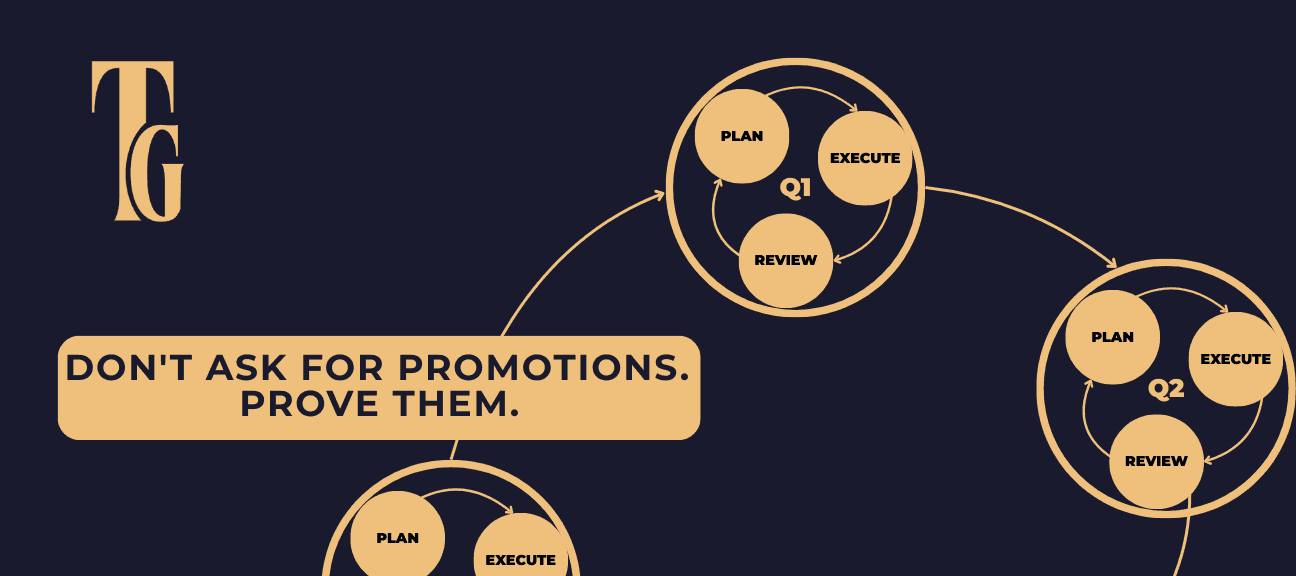
Waiting for your annual review to make your case? You're already behind.
The Internal Promotion Tool Nobody Uses (But Should)
You want the VP promotion. You've been performing well. You're waiting for your annual review to make your case.
Bad news: You're already behind.
The executives who get promoted aren't waiting for annual reviews to prove their value. They're building a documented track record of strategic delivery every single quarter.
As Westgate Branding explains:
"A 90-day plan helps to document, organize and create an action plan for the next quarter...a valuable tool to gain business credibility with upper management."
Here's the strategy nobody's using:
Quarterly 90-day plans create an ongoing track record of delivery. Every quarter, you present your plan to your boss. Every quarter, you show what you delivered.
By year-end, you don't need to make a case for promotion. You have four documented quarters of strategic impact sitting in front of them.
You're not begging for promotion. You're showing proof you've already been operating at the next level.
That's how senior executives get promoted without asking.
Here's exactly how to use 90-day plans as your internal promotion tool.
Why Annual Reviews Don't Get You Promoted
Let's start with the uncomfortable truth: Annual reviews are terrible promotion mechanisms.
Here's what happens in the typical annual review promotion attempt:
You: "I think I'm ready for the VP promotion."
Boss: "Tell me why you think that."
You: "Well, I've been doing great work. I've exceeded my targets. The team is performing well. I feel like I'm ready for the next level."
Boss: "I appreciate that. Let me think about it and discuss with leadership."
Translation: "You haven't given me anything concrete to take to the promotion committee."
Two weeks later:
Boss: "We've decided to hold off on the promotion for now. Keep doing what you're doing and we'll revisit next year."
What just happened?
You made a vague case based on feelings and general performance. Your boss had nothing concrete to advocate for you with. The promotion committee had no evidence that you're operating at VP level.
Result: No promotion.
The Four Fatal Flaws of Annual Review Promotion Attempts
Flaw 1: Recency Bias
Annual reviews focus heavily on the last 2-3 months. Everything you did in Q1 and Q2? Mostly forgotten.
You might have delivered incredible results in March. But if you had a rough November, that's what dominates the conversation.
Flaw 2: No Strategic Documentation
You're trying to recall your achievements from memory. You're scrambling to quantify impact that happened 8 months ago. You're hoping you can remember the important details.
Meanwhile, the executive who's been documenting quarterly has specific numbers, clear impact, and concrete evidence ready to go.
Flaw 3: Defensive Positioning
The annual review conversation forces you into a defensive position: "Here's why I deserve this."
That's not how promotions happen at the executive level. Promotions happen when leadership looks at you and thinks: "This person is already operating at the next level. We should formalize it."
Flaw 4: Single Data Point
One annual review is a single data point. Leadership is making a multi-year, high-stakes decision based on one conversation about one year.
That's not enough evidence to confidently promote someone into a VP or SVP role where mistakes are expensive.
The executives who get promoted have built a pattern of delivery that's impossible to ignore.
The Quarterly 90-Day Plan Strategy That Actually Works
Here's the promotion strategy nobody's using—but the ones who do use it get promoted consistently:
Every quarter, you present a 90-day plan to your boss.
Not a status update. Not a performance review. A strategic plan outlining:
- What you're going to deliver in the next 90 days
- Why these priorities matter strategically
- How you'll measure success
- What resources or support you need
Then, 90 days later, you present the results:
- What you committed to
- What you actually delivered
- What you learned
- What you're planning for the next quarter
By the end of the year, you have four documented quarters showing:
✓ Strategic thinking at the next level
✓ Consistent delivery of measurable results
✓ Clear communication with leadership
✓ Proactive ownership of your development
✓ Evidence you're already functioning as a VP/SVP
When promotion time comes, you don't make a case. The case has already been made.
The Psychological Power of Quarterly Documentation
There's deep psychology at work here that most people miss.
Principle 1: Pattern Recognition Over Single Events
Leadership doesn't promote based on one great quarter. They promote based on patterns of sustained excellence.
Four documented quarters of strategic delivery create an undeniable pattern. Your boss isn't wondering "Can they do this?" They're seeing "They've been doing this."
Principle 2: Already Operating at Next Level
The best way to get promoted is to start operating at the next level before the promotion.
Quarterly 90-day plans demonstrate VP/SVP-level strategic thinking. You're not asking for a chance to prove yourself. You're showing you're already there.
Principle 3: Making It Easy to Say Yes
Your boss wants to promote you. But they need to justify it to their boss, to the promotion committee, to HR.
When you hand them four quarters of documented strategic impact with clear metrics, you've done their work for them. You've built the case they need to advocate for you.
Principle 4: Avoiding Recency Bias
With quarterly documentation, your March achievements don't get forgotten in December. Every quarter is captured, measured, and preserved.
You've eliminated the single biggest flaw in annual review-based promotions.
The Quarterly 90-Day Plan Framework for Promotions
Let's break down exactly how to structure these quarterly plans to maximize promotion potential.
Quarter Planning Meeting (Week 13 of Previous Quarter)
Schedule 30-60 minutes with your boss to present your plan for the next quarter.
This isn't a casual check-in. This is a strategic planning session where you're demonstrating executive-level thinking.
Your presentation includes:
Section 1: Quarterly Situation Analysis
- Current state of your function/team
- Key challenges you're seeing
- Opportunities you've identified
- How these connect to company priorities
Why this matters: You're showing strategic awareness beyond just your tasks. You're thinking about the business holistically.
Section 2: Strategic Priorities for Next 90 Days
- Your 3-4 highest-impact priorities
- Why each matters (business impact, not just activity)
- How they sequence and connect
- Where they align with company/department goals
Why this matters: You're demonstrating prioritization and strategic thinking—hallmarks of senior leadership.
Section 3: Specific Deliverables and Metrics
- Concrete outcomes you'll deliver
- How you'll measure success
- Timeline for each deliverable
- Dependencies or risks you've identified
Why this matters: You're showing accountability and results-orientation at executive level.
Section 4: Resources and Support Needed
- What you need from your boss
- Cross-functional support required
- Budget or headcount implications
- Obstacles you've identified
Why this matters: You're not just executing—you're thinking about what's required for success and being proactive about securing it.
The conversation this creates:
You're not asking your boss what you should do. You're presenting strategic thinking and inviting their input.
Boss reaction: "This person is already thinking like a VP. They're not waiting to be told what to do—they're bringing strategy to me."
Quarter Review Meeting (Week 12-13 of Current Quarter)
Schedule 30-60 minutes to review what you actually delivered.
Your presentation includes:
Section 1: Commitments vs. Delivery
- What you said you'd deliver (from your plan)
- What you actually delivered
- Where you exceeded expectations
- Where you fell short and why
- What you learned
Why this matters: You're showing accountability. You're not hiding shortfalls—you're being transparent and demonstrating learning.
Section 2: Business Impact Achieved
- Quantified results from the quarter
- How they connected to company goals
- Unexpected wins or benefits
- Team development or capability built
Why this matters: You're speaking in terms of business outcomes, not activity. That's VP-level thinking.
Section 3: Strategic Insights Gained
- What you learned about the business
- Market or customer insights
- Process improvements identified
- What you'd do differently next time
Why this matters: You're not just doing tasks—you're building strategic knowledge that makes you more valuable.
Section 4: Preview of Next Quarter
- How next quarter builds on this one
- New priorities emerging
- Momentum you're carrying forward
Why this matters: You're demonstrating long-term strategic thinking, not just quarterly execution.
The conversation this creates:
You're not defending your performance. You're presenting documented evidence of strategic delivery. Your boss is seeing proof you can plan, execute, and learn at VP level.
Boss reaction: "This is the level of strategic thinking and execution I need at VP level. They're already doing it."
The Four-Quarter Promotion Strategy
Here's how the year-long strategy plays out:
Q1: Establish the Pattern
January: Present your Q1 90-day plan
- First time doing this, so focus on clarity and realism
- Don't overpromise—better to exceed modest goals
- Show you understand the business strategically
March: Present your Q1 results
- Show you delivered what you committed to
- Be honest about what you learned
- Preview Q2 plan
Boss takeaway: "This is new. Let's see if they can sustain it."
Q2: Build Credibility
April: Present your Q2 90-day plan
- Build on Q1 learnings
- Slightly more ambitious than Q1
- Show strategic evolution in your thinking
June: Present your Q2 results
- Demonstrate consistency (second quarter delivered)
- Show improvement from Q1 feedback
- Preview Q3 plan
Boss takeaway: "They're consistent. This isn't a one-quarter flash. They're building a track record."
Q3: Demonstrate VP-Level Strategic Thinking
July: Present your Q3 90-day plan
- This is where you stretch into VP-level priorities
- Take on bigger, more strategic initiatives
- Show you're thinking beyond your current scope
September: Present your Q3 results
- Show impact at broader organizational level
- Demonstrate leadership beyond your direct team
- Preview Q4 plan
Boss takeaway: "They're already thinking at VP level. They're not waiting for permission—they're just doing it."
Q4: Make Promotion Inevitable
October: Present your Q4 90-day plan
- Explicitly frame Q4 as VP-level work
- Take ownership of strategic initiatives
- Show you're ready for expanded scope
December: Present your Q4 results
- Demonstrate four quarters of consistent strategic delivery
- Show the pattern is undeniable
- Don't ask for promotion—let the evidence speak
Boss takeaway: "They've been operating at VP level for four quarters. The promotion is just formalizing what's already reality."
The Year-End Promotion Discussion
When promotion conversations happen (typically December/January), you don't make a case. You reference the evidence:
You: "As you've seen through our quarterly planning sessions this year, I've been focused on delivering VP-level strategic impact. Looking back at our four quarters together, I believe I've demonstrated consistent ability to think strategically, deliver measurably, and lead at that level. I'm ready to formalize that with the VP promotion."
What your boss sees:
Four documented quarters of:
- Strategic planning at VP level
- Consistent delivery of committed outcomes
- Measurable business impact
- Learning and adaptation
- Leadership beyond current scope
That's not a promotion request. That's evidence the promotion should have happened already.
The Tactical Execution: Making This Actually Happen
The strategy is clear. But execution is where most people fail. Here's how to actually make this work:
Step 1: Schedule Recurring Quarterly Meetings (Do This Today)
Block time on your boss's calendar for:
- Week 1 of every quarter: 60-minute planning session
- Week 12 of every quarter: 60-minute review session
Email to send:
"Hi [Boss],
I'd like to implement quarterly strategic planning sessions where I present my 90-day priorities and results. This will help us stay aligned on strategic direction and ensure I'm focused on highest-impact work.
Could we schedule:
- 60 minutes in Week 1 of each quarter for planning
- 60 minutes in Week 12 of each quarter for review
I'll come prepared with documented plans and results for each session. Let me know what works with your schedule."
Why this works: You're not asking permission to get promoted. You're proposing a professional development approach that makes you more effective.
Step 2: Create Your First 90-Day Plan (This Week)
Don't wait for the perfect moment. Start now with your current quarter.
Even if you're already 4 weeks into the quarter, create a plan for the remaining 8 weeks.
Your first plan includes:
1. Situation analysis (one page)
- Current state of your work/team/function
- Key challenges you see
- Opportunities identified
2. Priorities for remainder of quarter (one page)
- Your 3 highest-impact focuses
- Why each matters
- How you'll measure success
3. Specific deliverables (one page)
- What you'll deliver by end of quarter
- Timeline for each
- Resources needed
Total: 3 pages, clear and concise
Step 3: Present It Confidently
This isn't a status update. This is strategic planning.
Walk into the meeting with confidence:
"I've developed a 90-day strategic plan for this quarter. I'd like to walk you through my priorities and get your input on whether I'm focused on the right things."
Present your plan. Ask for feedback. Incorporate their insights.
Your boss will be impressed that you're being this proactive and strategic.
Step 4: Execute and Document
Over the next 90 days:
- Work your plan (but stay flexible)
- Document results as you deliver them
- Save metrics and outcomes
- Track learnings and insights
Don't wait until Week 12 to scramble for evidence. Build the evidence as you go.
Step 5: Present Your Results
Week 12, walk back in:
"Here's what I committed to at the start of the quarter. Here's what I actually delivered. Here's what I learned. And here's my thinking for next quarter."
This is where the pattern starts becoming visible.
Step 6: Repeat for Four Quarters
Consistency matters more than perfection.
Four solid quarters of strategic planning and delivery beats one perfect quarter and three mediocre ones.
By the end of the year, you'll have an undeniable track record.
Common Objections (And Why They're Wrong)
Objection 1: "My boss doesn't have time for quarterly meetings."
Your boss has time for what creates value. If you're bringing strategic thinking and measurable delivery, they'll make time.
Also: These meetings make their job easier. You're providing clarity on your priorities, demonstrating strategic thinking, and creating documentation they can use when advocating for you.
If they truly don't have time, document the plans anyway and send them via email. Still creates the pattern.
Objection 2: "This feels like I'm doing extra work on top of my job."
You're not doing extra work. You're documenting and strategically framing the work you're already doing.
The plan takes 2-3 hours per quarter to create. The review takes 1-2 hours to document.
That's 4-5 hours per quarter for a tool that dramatically increases promotion likelihood. Best ROI you'll get.
Objection 3: "What if I don't hit my goals? Won't that hurt me?"
Missing goals occasionally is fine—if you're transparent about why and what you learned.
Executive leadership isn't about perfection. It's about strategic thinking, accountability, and learning.
Hitting 80% of ambitious goals consistently is better than hitting 100% of easy goals.
Your boss cares more about the strategic thinking and accountability than the perfect execution.
Objection 4: "Isn't this manipulative? Like I'm gaming the system?"
Not at all. You're genuinely delivering value and documenting it clearly.
The "system" for promotions is broken—it relies on recency bias and vague impressions. You're fixing that by creating objective evidence of your impact.
If anything, you're making the system more fair by introducing concrete evidence into promotion decisions.
Objection 5: "What if my boss says no to the meetings?"
Then document the plans anyway and send them as emails:
"Hi [Boss], here's my strategic plan for Q2. Wanted to share my priorities and get your feedback on whether I'm focused on the right things."
90 days later: "Hi [Boss], here's what I delivered against my Q2 plan. Key learnings attached. Here's my preview of Q3 priorities."
Even without meetings, you're creating the documented pattern.
What This Looks Like in Practice
Let's make this concrete with a real example.
Sarah, Senior Director of Marketing, targeting CMO promotion:
Q1 (January-March):
January: Sarah presents her Q1 plan focusing on three priorities:
- Launch demand generation campaign targeting enterprise segment
- Rebuild marketing ops stack for better attribution
- Develop strategic plan for brand repositioning
She documents specific metrics for each priority and presents to her boss.
March: Sarah presents results:
- Campaign delivered 47 qualified leads (target was 40)
- Marketing ops stack implemented, attribution improved 60%
- Brand repositioning plan completed and approved by leadership
She documents what worked, what didn't, and previews Q2.
Q2 (April-June):
April: Sarah presents Q2 plan:
- Execute brand repositioning across all channels
- Scale enterprise demand gen based on Q1 learnings
- Build customer marketing program (expansion revenue focus)
June: Sarah presents results:
- Brand repositioning executed on schedule and under budget
- Enterprise pipeline grew 85% (exceeded 50% target)
- Customer marketing program launched, $2.1M expansion pipeline
Q3 (July-September):
July: Sarah presents Q3 plan with explicitly CMO-level scope:
- Develop go-to-market strategy for new product line
- Build strategic partnership with sales on revenue forecasting
- Present marketing strategy to board
September: Sarah presents results:
- Go-to-market strategy developed and approved
- Joint revenue forecasting model with sales built and implemented
- Board presentation delivered with strong feedback
Q4 (October-December):
October: Sarah presents Q4 plan continuing CMO-level work:
- Own complete revenue marketing strategy for next fiscal year
- Lead cross-functional alignment on company positioning
- Develop team capability plan for next year's growth
December: Sarah presents results:
- Fiscal year marketing strategy completed and approved
- Cross-functional alignment achieved through positioning workshops
- Team development plans for all direct reports completed
Promotion conversation (December):
Sarah: "Looking back at this year, I've been operating at CMO level for the past four quarters. The quarterly plans we've reviewed together show consistent strategic thinking, measurable delivery, and leadership beyond my current scope. I'm ready for the CMO promotion."
Boss: "I agree. You've been functioning as CMO for most of this year. Let me fast-track the paperwork."
That's not luck. That's strategy.
The Bottom Line
Waiting for your annual review to make your case for promotion? You're already behind.
The executives who get promoted aren't waiting. They're building documented track records of strategic delivery every single quarter.
As Westgate Branding explains:
"A 90-day plan helps to document, organize and create an action plan for the next quarter...a valuable tool to gain business credibility with upper management."
Document. Organize. Create action plans. Build credibility.
That's not annual review language. That's quarterly execution.
Here's the promotion strategy nobody's using:
Quarterly 90-day plans create an ongoing track record of delivery. Every quarter you present your plan. Every quarter you show what you delivered.
By year-end, you have four documented quarters of strategic impact.
You're not begging for promotion. You're showing proof you've already been operating at the next level.
The framework:
- Q1: Establish the pattern of strategic planning and delivery
- Q2: Build credibility through consistent execution
- Q3: Demonstrate next-level strategic thinking
- Q4: Make promotion inevitable through sustained excellence
The investment: 4-5 hours per quarter to document your strategic plans and results
The return: A promotion tool that transforms vague annual review discussions into objective evidence of readiness for the next level
Most people wait for their annual review and hope leadership notices their contributions.
You'll have four quarters of documented strategic impact that makes your promotion impossible to deny.
Ready to Build Your 90-Day Impact Portfolio?
The 90-Day Impact Portfolio provides everything you need: structure, examples, templates, and strategic frameworks for creating quarterly plans that get you promoted.
Get The 90-Day Impact Portfolio and start building your promotion track record this quarter.
Contact Me to discuss your specific promotion strategy and get personalized guidance.
Join My Newsletter for weekly career advancement strategies and insights.
Written by
Bill Heilmann