The 3-Step Fractional Executive Blueprint: From W-2 Dependency to Multiple High-Value Clients
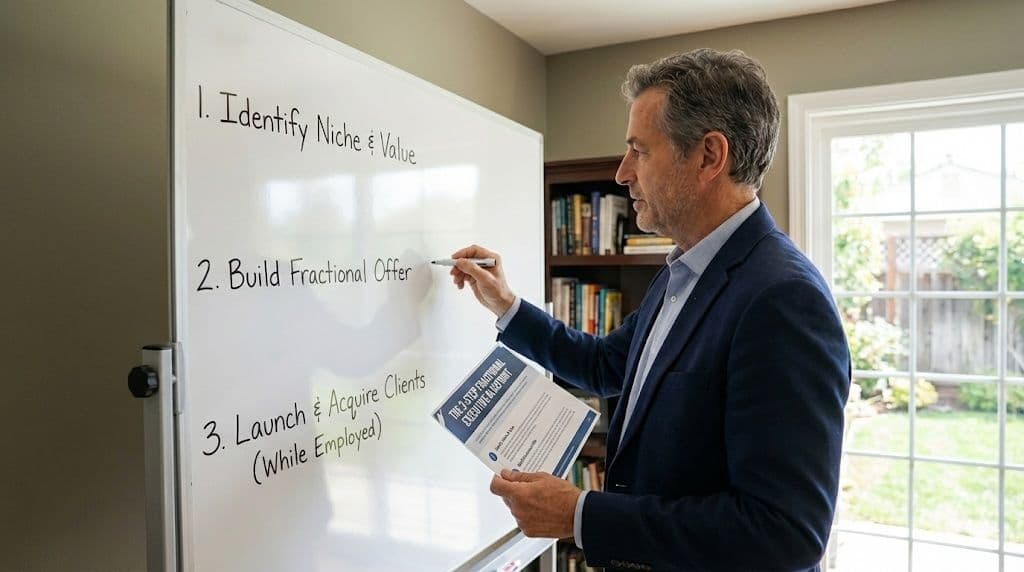
The complete framework for transitioning to fractional work while employed.
The 3-Step Fractional Executive Blueprint: From W-2 Dependency to Multiple High-Value Clients
Yesterday I walked you through the RSU trap and why golden handcuffs often cost more than they're worth.
Today I want to show you Part 2 of The 2026 AI Revolution Career Guide: The 3-Step Fractional Executive Blueprint.
This is the complete framework for transitioning from W-2 dependency to multiple high-value clients—whether you go full fractional or maintain a hybrid model.
Not theory. The actual system that VPs, Directors, and Senior ICs are using right now to build $300K-$500K+ fractional practices.
Here are the three steps that transform "I'm a VP at BigTech" into "I have three clients paying me $12K-$18K monthly each."
What Fractional Executive Work Actually Is
Before diving into the three steps, let's clarify what we're talking about:
Fractional executive work is NOT:
- Hourly consulting projects
- Short-term contractor roles
- Interim executive placements
- "Between jobs" consulting
Fractional executive work IS:
- Ongoing embedded leadership
- Strategic value at 20-40% capacity
- Monthly retainer relationships
- Long-term partnerships (6-24+ months typical)
The model:
You provide executive-level strategic leadership to multiple companies simultaneously, each paying you a monthly retainer for a defined portion of your capacity.
Example:
- Client A: CMO-level marketing leadership, 25% capacity, $12K/month
- Client B: VP Marketing strategic advisor, 20% capacity, $10K/month
- Client C: Board advisor, 10% capacity, $6K/month
- Total: 55% capacity, $28K/month = $336K annually
This is the model we're building toward.
Why This Model Works for Senior Professionals
Before showing you the three steps, understand why fractional work makes sense in 2026:
Reason 1: Companies Want It
What's driving demand:
- Need executive expertise without full-time cost
- Want specialized skills for specific challenges
- Scaling requires leadership they can't afford full-time
- Board/investor pressure to stay lean
- AI replacing mid-level, but strategic leadership still needed
The market:
Fractional CMO, CFO, CRO, CTO roles are now mainstream. Companies actively budget for fractional leadership.
Reason 2: Economics Work for You
The math:
Traditional W-2: $450K total comp = 100% of your capacity
Fractional: 3 clients at $12K/month = $432K at 60% capacity
You earn similar money working less, with:
- More control over schedule
- Diversified income (safer)
- Ability to scale up or down
- Location independence
- No organizational politics
Reason 3: Your Expertise Is Valuable
What makes you fractional-ready:
- 10+ years of experience
- Deep expertise in specific domain
- Track record of results
- Can operate strategically without hand-holding
- Solve expensive problems
Your years of experience become your product.
Reason 4: Risk Is Actually Lower
Compared to W-2:
One client ends → Still earning $24K/month from other two
Company restructures → Doesn't affect you
AI displaces role → You've already diversified
The fractional model is more resilient, not less.
Now let's build it.
Step 1: Value Identity Shift
Timeline: Weeks 1-4
Goal: Transform how you position yourself professionally
This is the foundation everything else builds on. You can't sell fractional services while thinking like an employee.
The Mindset Transformation
From employee identity:
"I'm VP of Product at Amazon"
To value identity:
"I help B2B SaaS companies scale product organizations from $10M to $100M ARR while maintaining velocity"
Why this matters:
One is a job title tied to a company. The other is a service companies will pay for.
The Value Identity Formula
Answer three questions:
Question 1: Who do you help?
Be specific about company type:
- Industry (B2B SaaS, FinTech, HealthTech)
- Stage ($10M-$100M revenue, Series B-C)
- Situation (scaling, turnaround, launching new product)
Bad: "Companies" -Good:* "B2B SaaS companies from $10M to $100M in revenue"
Question 2: What outcome do you create?
Quantify the transformation:
- Revenue growth ($10M to $100M)
- Cost reduction (40% operational efficiency)
- Team scaling (20 to 100+ people)
- Speed improvement (3-month to 3-week launches)
Bad: "Help them grow" -Good:* "Scale product organizations from 20 to 100+ people while maintaining velocity"
Question 3: What's your unique approach?
Your frameworks and methodologies:
- Specific processes you've developed
- Unique insight or perspective
- Pattern recognition from multiple companies
- Frameworks that transfer across contexts
Bad: "I have experience" -Good:* "Using the staged scaling framework I've applied at four companies, focusing on team structure, decision rights, and maintaining quality"
Your Complete Value Identity
The formula:
"I help [specific type of company] achieve [quantified outcome] through [your unique approach]"
Examples:
Product Leader:
"I help B2B SaaS companies scale product organizations from $10M to $100M ARR. Using frameworks developed across four scale-ups, I focus on team architecture, roadmap prioritization, and maintaining velocity while growing from 20 to 100+ people."
Engineering Leader:
"I build engineering cultures that ship fast and retain top talent. At three companies, I've scaled engineering teams from 15 to 100+ while maintaining <8% attrition and improving deployment frequency from monthly to daily."
Revenue Operations Leader:
"I optimize revenue operations for Series B-D companies accelerating from $20M to $100M. My approach combines process design, tech stack optimization, and data infrastructure that typically increases sales efficiency by 30-40%."
Marketing Leader:
"I build demand generation engines for B2B SaaS companies. Across five companies, I've scaled marketing from $2M to $20M+ in pipeline generation using account-based strategies optimized for $50K+ ACV products."
The Documentation Process
Week 1-2: Document your expertise
Create a working document answering:
- What specific problems have you solved repeatedly?
- What frameworks or methodologies have you developed?
- What outcomes have you created (with numbers)?
- What makes your approach unique or transferable?
- Who benefits most from your expertise?
This becomes your IP (intellectual property).
The Testing Phase
Week 3-4: Test your value identity
Use your new identity statement in:
- LinkedIn profile headline and about section
- Networking conversations (virtual and in-person)
- Email signature
- Any professional introduction
Observe:
- Does it feel authentic when you say it?
- How do people respond?
- Does it open conversations or close them?
- What questions does it generate?
Refine based on feedback until it feels natural.
Step 1 Success Metrics
You've completed Step 1 when:
✅ You can introduce yourself without mentioning title or company
✅ Your value identity statement feels authentic
✅ You've documented 5-10 frameworks/methodologies you've developed
✅ People respond with "tell me more" instead of blank stares
✅ Your LinkedIn profile reflects value-based positioning
✅ You think of yourself as solving problems, not holding a title
Time investment: 10-15 hours over 4 weeks
This foundation makes everything else possible.
Step 2: Retainer Pricing Model
Timeline: Weeks 5-8
Goal: Understand how fractional pricing works and set your rates
Fractional isn't hourly consulting. It's ongoing embedded leadership at monthly retainers.
Understanding this pricing model is critical to positioning correctly.
How Fractional Pricing Actually Works
Not hourly:
Clients don't pay you $200/hour for 60 hours = $12K
Monthly retainers:
Clients pay you $12K/month for strategic leadership at ~25% capacity
Why retainers, not hours:
- Predicts their costs (budget certainty)
- Ensures your availability (you're "on the team")
- Values strategic thinking (not just execution time)
- Allows flexibility (some weeks 5 hours, some 15 hours)
- Creates ongoing relationship (not transactional)
This is how companies prefer to work with fractional executives.
The Capacity Model
How to think about fractional capacity:
Full-time W-2 = 100% capacity
- 40+ hours weekly
- Available constantly
- Deep in day-to-day operations
- Limited time for strategic thinking
Fractional at 25% = Strategic leadership
- 10-12 hours weekly
- Available for key decisions/meetings
- Focused on strategy, not execution
- Delegates tactical work to their team
The model:
You provide executive-level strategic guidance. The client's team handles execution. You're not a contractor doing the work—you're leadership guiding the team.
Typical capacity allocations:
- 20-25%: Primary strategic advisor role
- 15-20%: Secondary advisory or board role
- 10-15%: Light advisory or specialized expertise
- 5-10%: Board advisor or very specific expertise
Most fractional executives maintain 2-3 primary clients (20-25% each) = 60-75% capacity.
Setting Your Rates
The formula:
Take your W-2 total compensation, divide by 12 months, adjust for capacity and value.
Example calculation:
Your W-2 comp: $450K annually -Monthly equivalent:* $37.5K/month -At 25% capacity:* $9,375/month baseline
Adjustments:
Add 20-30% for:
- No benefits cost to them (you cover your own)
- Specialized expertise premium
- Proven track record
- High-demand expertise
Your fractional rate: $11K-$13K/month at 25% capacity
Common fractional rate ranges by role:
VP/C-level Marketing (CMO): $12K-$18K/month (25-30% capacity) -VP/C-level Revenue Ops (CRO):* $15K-$20K/month (25-30% capacity) -VP/C-level Engineering (CTO):* $12K-$18K/month (20-25% capacity) -VP/C-level Product (CPO):* $12K-$18K/month (25-30% capacity) -VP/C-level Finance (CFO):* $10K-$15K/month (15-20% capacity) -Director-level specialists:* $8K-$12K/month (20-25% capacity) -Advisory/Board roles:* $3K-$8K/month (5-10% capacity)
The math for 3 clients:
Client A: $12K/month (25% capacity)
Client B: $12K/month (25% capacity)
Client C: $10K/month (20% capacity)
-Total: $34K/month = $408K annually at 70% capacity*
The Engagement Structure
What fractional engagements typically include:
Strategic leadership:
- Weekly or bi-weekly strategic meetings
- Key decision participation
- High-level problem solving
- Framework and process design
Team guidance:
- Coaching client's team members
- Reviewing critical deliverables
- Providing expert perspective
- Unblocking major obstacles
Availability:
- Responsive to urgent strategic needs
- Async communication (Slack, email)
- Attendance at critical meetings
- Flexible hours based on needs
What's typically NOT included:
- Day-to-day execution (their team does this)
- Attending every meeting (only strategic ones)
- Being available 24/7
- Hands-on tactical work
The boundary is critical: You're strategic leadership, not a full-time employee.
Contract Basics
Typical fractional contract terms:
Duration: 6-12 months initial, then month-to-month or renewal -Payment:* Monthly retainer (beginning of month) -Capacity:* Defined % or hour range (but retainer, not hourly) -Scope:* Strategic areas you're responsible for -Termination:* 30-60 day notice typical -IP:* Work product belongs to client
You'll need:
- Standard contract template
- SOW (Statement of Work) template
- Payment terms clearly defined
- Capacity boundaries specified
Step 2 Success Metrics
You've completed Step 2 when:
✅ You understand retainer vs. hourly pricing model
✅ You've calculated your fractional rate ($X/month at Y% capacity)
✅ You can explain value of retainer model to prospective clients
✅ You have contract and SOW templates ready
✅ You understand typical engagement structure
✅ You're clear on boundaries (strategic vs. tactical)
Time investment: 8-12 hours over 4 weeks
Now you know how to price and structure engagements.
Step 3: Financial Launch Plan
Timeline: Weeks 9-52 (9-12 months)
Goal: Land your first client and build toward sustainable fractional income
This is where theory becomes reality. The step-by-step plan to go from zero fractional clients to $150K-$400K in fractional income.
The Phased Approach
Phase 1: First Client While Employed (Months 1-3)
Goal: Land one advisory or fractional client at $5K-$10K/month
Why start small:
- Prove the model works
- Build confidence
- Create case study
- Learn while low-risk
- Keep W-2 for security
Activities:
Month 1: Positioning and outreach
- Update LinkedIn with value-based positioning
- Identify 20 potential clients (companies that need your expertise)
- Reconnect with 10 warm network contacts
- Draft outreach messaging
Month 2: Conversations and proposals
- Have 10-15 exploratory conversations
- Focus on companies with specific pain points you solve
- Lead with value, not "I'm available"
- Send 2-3 formal proposals
Month 3: Close and deliver
- Close first client at $5K-$10K/month
- Sign contract, begin engagement
- Deliver exceptional value in first 60 days
- Document your approach and outcomes
Success metric: One paying client, $60K-$120K annual run rate, while maintaining W-2
Phase 2: Build Foundation (Months 4-6)
Goal: Add second income source and optimize delivery
Activities:
Month 4: Optimize first client
- Refine delivery model
- Create reusable frameworks
- Build systems for efficiency
- Document case study
Month 5: Second client search
- Leverage success from Client 1
- Use case study in outreach
- Target similar company profile
- Ask Client 1 for referrals
Month 6: Add second client
- Close second client at $8K-$12K/month
- Now earning $13K-$22K/month fractional
- Total: $156K-$264K annually fractional
- Still maintaining W-2
Success metric: Two clients, $150K-$250K+ annual fractional income, proven delivery model
Phase 3: Decision Point (Months 7-9)
Goal: Decide your path forward
Three options:
Option A: Stay hybrid (W-2 + fractional)
- Negotiate reduced W-2 to 4 days/week or 80% capacity
- Maintain 2 fractional clients
- Total comp: Reduced W-2 + fractional = $450K-$550K+
- Best of both worlds
Option B: Go full fractional
- Give notice at W-2
- Scale to 3rd client
- Full-time fractional at $300K-$500K+
- Complete independence
Option C: Stay W-2, maintain fractional optionality
- Keep both clients as backup/insurance
- Extra $150K-$250K annually
- Career safety net established
- Can transition later if needed
The decision:
Based on:
- Risk tolerance
- Financial runway
- W-2 situation (is role secure?)
- Enjoyment (prefer fractional or W-2?)
- Income goals
There's no "right" answer—choose what fits your goals.
Phase 4: Scale or Optimize (Months 10-12)
If going full fractional:
Month 10: Add third client
- Target $10K-$15K/month
- Total: $28K-$37K/month = $336K-$444K annually
- At 60-75% capacity
Month 11-12: Optimize and systematize
- Refine delivery processes
- Build referral systems
- Increase rates (10-20%)
- Establish sustainable practice
If staying hybrid:
Month 10-12: Optimize balance
- Streamline fractional delivery
- Maintain W-2 performance
- Build financial cushion
- Enjoy diversified income
The Financial Bridge
How to manage income during transition:
Months 1-6 (Building):
- W-2 income: 100%
- Fractional income: Building to 30-50% of W-2
- Total: 130-150% of W-2
- Banking the extra
Months 7-9 (Decision):
- W-2 income: 100% (if staying) or giving notice
- Fractional income: 50-70% of W-2
- Bridge: Severance + savings if leaving
Months 10-12 (Scaled):
- W-2 income: 0% (if left) or 80% (if hybrid)
- Fractional income: 90-120% of previous W-2
- Total: Similar or higher total comp
The bridge ensures you never have zero income.
Client Acquisition Strategy
Where fractional clients come from:
Not cold outreach (5% of clients):
- Mass LinkedIn messages
- Cold email campaigns
- Posting "available for fractional work"
Warm network activation (60% of clients):
- Former colleagues who moved to new companies
- People who've seen your work
- Mutual connections and referrals
- People who've followed your content
Referrals from existing clients (30% of clients):
- Client 1 refers you to peer
- Portfolio company introductions
- Board member connections
Inbound from visibility (5% of clients):
- LinkedIn content positioning
- Speaking at events
- Podcast appearances
The strategy:
Months 1-3: Warm network activation
Months 4-6: Client 1 referrals + continuing warm network
Months 7-12: Referrals become primary engine + inbound
Build a system that feeds itself.
Step 3 Success Metrics
You've completed Step 3 when:
✅ You've landed first client ($5K-$10K/month)
✅ You've delivered value and have case study
✅ You've added second income source
✅ You're earning $150K-$250K+ annually fractional
✅ You've made informed decision on path forward
✅ You have sustainable client acquisition system
Time investment: 5-10 hours weekly over 9-12 months
You've transitioned from W-2 dependency to fractional optionality.
Real Examples: The Three Steps in Action
Example 1: Marketing Leader → Fractional CMO
Jane, VP Marketing, Age 42, $420K total comp
Step 1 (Month 1-2):
- Shifted from "VP Marketing at TechCo"
- To: "I build demand generation engines for B2B SaaS companies, scaling from $2M to $20M+ in pipeline"
- Documented 8 frameworks developed across 3 companies
Step 2 (Month 2-3):
- Calculated fractional rate: $14K/month at 25% capacity
- Created contract templates
- Understood retainer model
Step 3 (Month 3-12):
- Month 3: First client at $10K/month (former colleague's new company)
- Month 6: Second client at $12K/month (referral from Client 1)
- Month 8: Gave notice at W-2
- Month 10: Third client at $14K/month
- Result: $36K/month = $432K annually, 65% capacity, complete control
"I earn the same money working 25 hours weekly instead of 50+. The three-step framework made it systematic instead of scary."
Example 2: Product Leader → Fractional CPO (Hybrid Model)
David, Director of Product, Age 39, $340K total comp
Step 1 (Month 1):
- Shifted identity to value-based positioning
- "I help Series B companies scale product organizations from 20 to 100 people"
Step 2 (Month 2):
- Set rate at $10K/month for 20% capacity
- Understood strategic vs. tactical boundary
Step 3 (Month 3-9):
- Month 4: First advisory client at $8K/month
- Month 7: Second client at $10K/month
- Month 9: Negotiated W-2 to 4 days/week at $272K
- Result: $272K W-2 + $216K fractional = $488K total, more balance
"I didn't want to leave W-2 entirely, so I built hybrid model. Now I earn 40% more for less total hours."
Example 3: Engineering Leader → Fractional CTO
Michael, Engineering Director, Age 44, $380K total comp
Step 1 (Month 1-2):
- Documented technical architecture frameworks
- Positioned as distributed systems expert
Step 2 (Month 2-3):
- Set premium rate: $15K/month (specialized expertise)
- Created technical advisory engagement model
Step 3 (Month 3-10):
- Month 3: First client at $12K/month (startup CTO advisory)
- Month 5: Second client at $15K/month (Series B technical advisor)
- Month 8: Added board advisor role at $5K/month
- Month 9: Gave notice at W-2
- Result: $32K/month = $384K annually, 50% capacity
"Three steps gave me confidence to make the leap. The financial launch plan meant I wasn't scrambling."
The Timeline Summary
Here's what the complete three-step blueprint looks like:
Weeks 1-4: Step 1 (Value Identity Shift)
- Document expertise and frameworks
- Create value-based identity statement
- Test positioning with network
- Update LinkedIn and materials
- Time: 10-15 hours total
Weeks 5-8: Step 2 (Retainer Pricing Model)
- Calculate fractional rates
- Understand engagement structure
- Create contract templates
- Learn delivery model
- Time: 8-12 hours total
Weeks 9-52: Step 3 (Financial Launch Plan)
- Months 1-3: Land first client ($5K-$10K/month)
- Months 4-6: Add second client, build foundation
- Months 7-9: Decision point (hybrid vs. full fractional)
- Months 10-12: Scale or optimize
- Time: 5-10 hours weekly
Total timeline: 9-12 months from start to sustainable fractional practice
Total time investment: 250-350 hours over 12 months
Result: $150K-$500K+ fractional income with optionality and control
The Bottom Line
The 3-Step Fractional Executive Blueprint is the complete framework for transitioning from W-2 dependency to multiple high-value clients:
Step 1: Value Identity Shift
- Stop "VP of Product at Amazon"
- Start "I help B2B SaaS scale from $10M to $100M ARR"
- One is a job title. The other is a service companies pay for.
Step 2: Retainer Pricing Model
- Fractional isn't hourly consulting
- It's ongoing embedded leadership at 20-40% capacity
- $12K-$18K per month retainers
- 2-3 clients = $300K-$500K+ annually
Step 3: Financial Launch Plan
- Don't quit tomorrow
- Test while employed
- Land one advisory client
- Prove the model, build case studies, scale
- 9-12 months to sustainable practice
VPs, Directors, and Senior ICs are doing this right now.
Building optionality while employed.
Creating $300K-$500K+ fractional practices with more control, less risk, and better work-life balance than their W-2 roles ever provided.
The three-step blueprint makes it systematic instead of scary.
Ready to Build Your Fractional Practice?
If you want help implementing this three-step blueprint for your specific situation, I can guide you through the process.
Book a Strategy Call to discuss your fractional positioning and launch plan.
Join My Newsletter for early access to The 2026 AI Revolution Career Guide when it launches mid-January.
Download The Headhunter's Playbook for tactical strategies for navigating career transitions.
Tomorrow: Part 3 deep dive - The New Business Model for senior professionals.
Written by
Bill Heilmann